
 Sarah Grey
Even smart and reflective women can stay in draining partnerships, despite clear thinking. It is not that these individuals miss the signs – emotions tie tightly to personal background and future aspirations. What seems like hesitation from afar hides layers of commitment, shared experiences, and inner conflict. Connection weighs heavily on bonds formed over time, making exit difficult, even when logic points elsewhere.
From the outside, the situation can look baffling. A capable, intelligent woman stays with a partner who diminishes her, and friends wonder why she does not simply leave. The assumption is that intelligence should protect against bad relationships. But emotional bonds do not follow the rules of logic, and the very traits that make a woman smart can also keep her stuck.
Psychologists have studied this pattern for decades. The reasons are layered and deeply human, involving attachment, identity, hope, fear, and the slow erosion of self-trust. Understanding them does not excuse a harmful relationship, but it replaces judgment with insight, which is the first step toward change.
Here are ten reasons why intelligent women sometimes remain in emotionally draining relationships, and what each one reveals about the heart.
Emotional Investment Creates Strong Attachment

If years of effort go into building a connection – shared moments, trust, effort – just leaving might seem like walking away from part of who you are. The more feelings run deep, the blurrier that line gets between reason and longing.
Attachment is not a character flaw. It is the same force that bonds parents to children and friends to one another. When a woman has invested years in a partnership, her identity becomes woven into it. The shared home, the routines, the private jokes, the history – all of it feels like an extension of herself.
Smart women often understand attachment theory intellectually, which can make the experience more confusing, not less. Knowing that your bond is partly chemical and habitual does not switch it off. The heart does not consult the textbook before it aches.
Investment also creates a sense of meaning. The years were not just spent; they were lived. Walking away can feel like declaring those years worthless, even when staying costs more. This is why the attachment of long investment is one of the strongest forces keeping intelligent women in place.
Recognizing attachment as a real force, rather than a weakness, is the beginning of loosening its grip. The bond is valid. The question is whether it is still serving the person it binds.
Change Seems Possible at First Glance

Smart women usually think people can grow and do better. So it makes sense to think a tough relationship might get better. If small happy times come up now then, those seem like proof things are changing. That kind of proof keeps her hoping real shift happens.
Intelligent people are, by nature, believers in growth. They have seen themselves change, learn, and improve, so they extend the same possibility to others. When a partner shows flashes of kindness or insight, it feels like evidence that transformation is underway.
The trouble is that intermittent good moments are also the most powerful reinforcers. Psychologists call it variable reinforcement: unpredictable rewards keep behavior going far longer than consistent ones. A partner who is wonderful ten percent of the time can be harder to leave than one who is never kind.
Hope is not naive. It is one of the most human responses to love. But hope needs to be checked against patterns, not moments. A smart woman can learn to ask a harder question: not whether change is possible, but whether it is actually happening, consistently, over time.
Growth is real, and people do change. The distinction that matters is between potential and pattern. Potential is a story about the future. Pattern is the truth of the present.
Responsibility Is Taken Too Personally

Some women who notice how they feel often look at their own actions, wondering where things could go better. Though checking in with yourself helps in plenty of cases, it sometimes means holding onto guilt without reason. That inner review might miss the bigger picture.
Self-reflection is a strength, but it has a shadow side. A woman who is used to taking responsibility at work, in her family, and in her friendships may apply the same standard to her relationship. If something is wrong, her first question is what she did wrong.
This tendency can be exploited, sometimes deliberately and sometimes not. A partner who deflects blame will find a willing recipient in someone who already blames herself. Over time, she may carry responsibility for problems she did not create and cannot fix.
The reframe is simple but difficult: responsibility in a relationship is shared. One person cannot fix a dynamic alone, and one person is not the cause of every conflict. Smart women can practice directing their analytical minds outward as well as inward, asking what the other person is contributing to the problem.
Taking responsibility is admirable. Taking all of it is not responsibility. It is self-erasure, and it keeps her working on herself while the real issues go unaddressed.
Empathy Can Blur Boundaries

Seeing through another’s experience helps grasp their pressure, background, or challenges. When moments pile up, kindness might weaken limits, particularly if parting seems like walking away from someone hurting.
Empathy is one of the finest human qualities, and intelligent women often have it in abundance. They can see the wounded child behind a partner’s anger, the stress behind the withdrawal, the fear behind the control. This understanding is real and valuable.
But understanding someone’s pain is not the same as accepting harmful behavior. Empathy explains; it does not excuse. When empathy keeps overriding boundaries, it stops being compassion and becomes self-abandonment.
The pattern often looks like this: he acts hurtfully, she understands why, she forgives, nothing changes, the cycle repeats. Her empathy becomes the mechanism that absorbs the impact, protecting him from consequences and her from the clarity that consequences would bring.
Healthy empathy includes the self. A woman can hold compassion for her partner’s struggles while still insisting on being treated well. Boundaries are not the opposite of love. They are what make love sustainable.
Fear of Wasted Time Influences Decisions
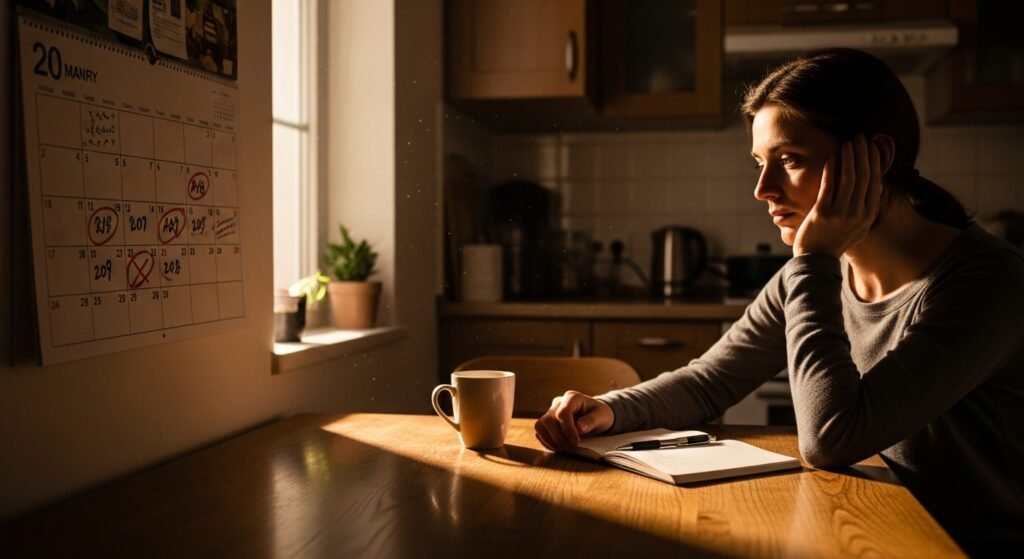
When time goes on in a partnership, seeing fresh beginnings fade gets harder. People sometimes stick because what has already happened feels lost if walked away – this trap is known as the sunk cost bias. Staying often seems less painful than walking out.
The sunk cost fallacy is well documented in economics, and it applies brutally to relationships. Five years, ten years, twenty years: the longer the investment, the harder it feels to walk away. The mind whispers that leaving means those years were wasted.
But the years are already spent. They cannot be recovered by staying, and staying adds more years to the same account. The only real question is about the future: do you want more years like these, or different ones?
Smart women are not immune to this bias. In fact, their ability to construct sophisticated rationalizations can make it worse. They can build elaborate arguments for why the investment will eventually pay off, using their intelligence to defend a decision their heart has already made.
The years were not wasted if they taught you something. Every relationship, even a painful one, delivers knowledge about what you need and what you will not accept again. That knowledge is the return on the investment, and you take it with you.
External Expectations Add Pressure

What people around her think can quietly shape her choices. Family ties, friendships, culture – they all hint that staying put matters more than pushing forward. A strong, self-reliant woman might still sense an unspoken weight pulling her toward continuity. Others views on effort and duty sometimes slip into her decisions without fanfare.
No relationship exists in a vacuum. Families have opinions. Communities have norms. Religious and cultural traditions may treat marriage as permanent and separation as failure. Even well-meaning friends may urge patience without understanding the full picture.
For a woman who is admired for having it all together, admitting that her relationship is failing can feel like a public failure. The pressure to maintain the image of a successful partnership can be enormous, especially when others look up to her.
Children add another layer. The desire to keep a family intact is powerful and legitimate. But children also absorb the emotional climate of a home. Research consistently shows that children fare better with happy separated parents than with miserable together ones.
Other people’s expectations are data, not directives. A smart woman can listen to them, weigh them, and still make her own choice. The life being lived is hers, not the audience’s.
Confidence Can Be Gradually Eroded

Slow changes in how people interact tend to go unnoticed, yet they leave deep marks. When feedback constantly feels cold or unappreciative, self-doubt creeps in quietly. Staying in a situation that once seemed manageable may now feel impossible – even if reason says otherwise.
Erosion is gradual by definition. Nobody wakes up one morning with shattered confidence. It happens in small moments: the dismissive comment, the eye roll, the achievement that goes unacknowledged, the opinion that gets talked over. Each one is minor. Together, they reshape how a woman sees herself.
Intelligent women may be especially vulnerable because they are used to trusting their judgment. When a partner consistently undermines that judgment, the resulting confusion is profound. She begins to doubt the very mind that has served her well everywhere else.
This is why leaving can feel impossible even when it looks obvious from outside. The woman on the outside sees a capable person. The woman on the inside feels like someone who cannot trust her own perceptions. The gap between those two views is the damage.
Confidence can be rebuilt, often faster than expected once the erosion stops. Distance brings clarity. Supportive relationships remind her who she is. The capable woman was there all along, buried under years of quiet diminishment.
Problem-Solving Skills Encourage Endurance

A sharp mind in a woman can turn problems into puzzles to untangle. Rather than leave, some see tension as an obstacle with hidden fixes, convinced that patience and planning bring order back.
Problem-solving is a superpower in most areas of life. It builds careers, fixes systems, and untangles complexity. But a relationship is not a puzzle, and a partner is not a problem to be solved. Applying engineering logic to emotional dynamics can keep a woman working on something that cannot be fixed by effort alone.
The pattern is familiar: read the books, try the communication techniques, suggest the therapy, adjust the approach, try again. Each attempt feels productive. Each failure feels like a sign to try harder rather than a sign to stop.
What the problem-solver misses is that some problems are not hers to solve. A relationship requires two willing participants. No amount of strategy can change a partner who does not want to change, and no communication technique works with someone who refuses to listen.
The bravest application of problem-solving is recognizing an unsolvable problem. Walking away is not giving up. It is the correct solution to the wrong equation.
What Happens Next Feels Too Heavy to Carry

Familiarity lingers in a tired partnership. Facing what comes next might scare her more than staying where pain repeats itself. Big choices loom large when picking a path feels untested.
The unknown is genuinely frightening. Leaving means facing logistics, finances, housing, custody, loneliness, and the opinions of others, all at once. For a woman who has built her life around a partnership, the practical weight of starting over can feel crushing.
Smart women can see every obstacle with unusual clarity, which is both a gift and a curse. Where someone else might leap without looking, she sees the full landscape of difficulty ahead. That clarity can paralyze.
But the weight of the unknown is almost always lighter than imagined. The logistics get handled one step at a time. The loneliness passes. The finances stabilize. What felt like a cliff turns out to be a staircase, climbed one step at a time.
Familiar pain is still pain. The comfort of the known is real, but it is not a good enough reason to stay in something that is draining the life out of you.
Love and Loyalty Complicate Logic

Even when things get heavy, what stays is how she feels about you – those moments you can not measure. Her mind may see the warning signs, yet something deeper holds on first. What lingers is not just habit; it is where connection turns into quiet duty.
Love does not switch off when a spreadsheet says it should. A woman can know every reason to leave and still feel the pull of affection, history, and tenderness. This is not irrationality. It is the nature of love, which was never a purely logical enterprise.
Loyalty deepens the bind. Many women were raised to see loyalty as a core virtue, and breaking a commitment feels like breaking faith with themselves. The vows, the promises, the shared dreams: all of them argue for staying.
But loyalty to another person should not require disloyalty to yourself. A commitment made to a partnership assumes a partnership in return. When one person has stopped showing up emotionally, the contract has already been broken, just not formally.
Love and loyalty are beautiful qualities. They deserve to be directed toward someone who returns them, including the woman herself.
Finding the Way Forward
If you recognize yourself in these patterns, know that understanding them is already progress. Awareness does not instantly dissolve attachment or fear, but it changes the conversation from why am I so weak to what is actually happening here. That shift matters.
Consider talking to a therapist, a trusted friend, or a support group. Outside perspective breaks the spell of rationalization. Journaling can help too, because writing forces the vague into the specific, and the specific is harder to argue with.
Above all, extend to yourself the compassion you so freely give others. You would never judge a friend for loving deeply or hoping for change. Offer yourself the same grace, and let that grace include the possibility of choosing yourself.
Smart women stay in draining relationships for deeply human reasons. Smart women also leave them, rebuild, and thrive. Both are true, and the second can be your story too.