 Sarah Grey
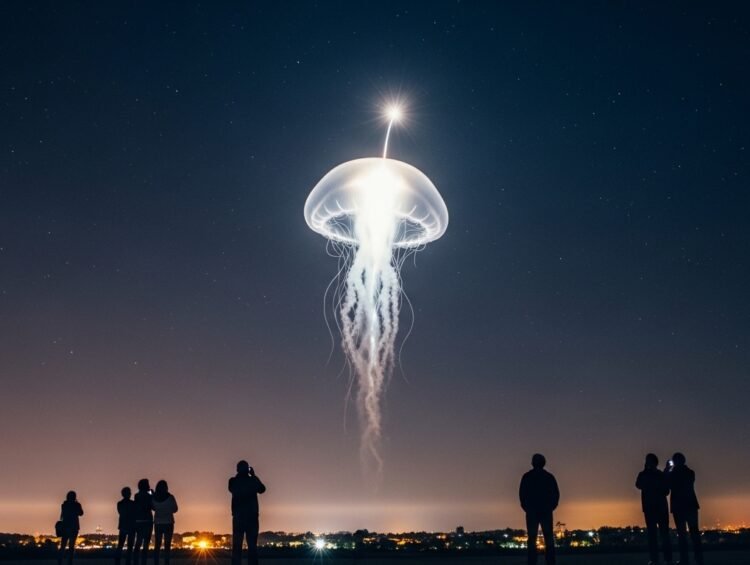
On a clear evening, millions of Americans looked up at the night sky and saw something they would never forget. A glowing, ethereal shape drifted slowly across the heavens, expanding as it moved. It had a bright, rounded head and long, flowing tendrils that trailed behind it like the tentacles of a jellyfish swimming through deep water. Except this jellyfish was not in the ocean. It was in space, or at least, it looked that way. Within minutes, social media exploded with photos, videos, and breathless speculation. What was this strange, beautiful apparition?
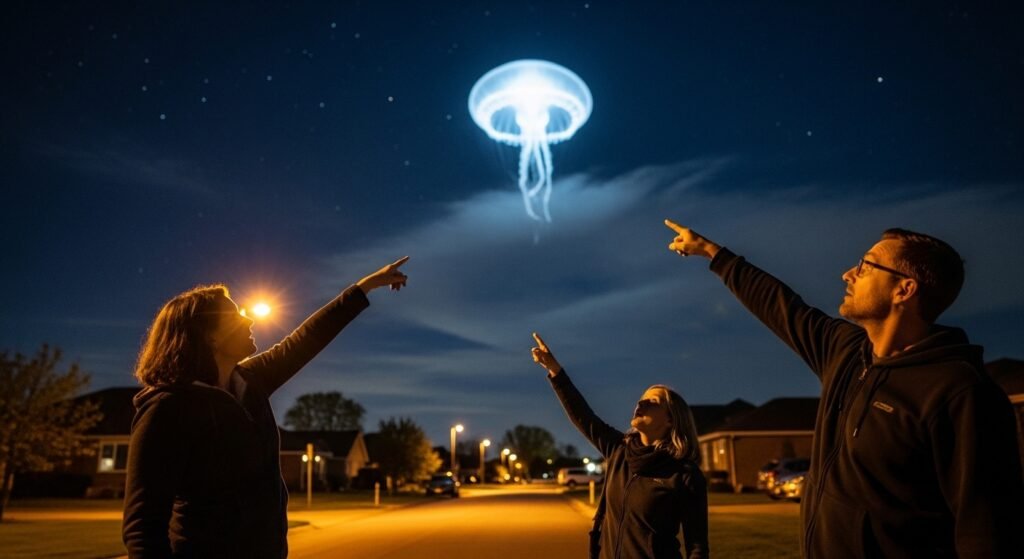
The phenomenon, which quickly became known as a space jellyfish, was visible across multiple states. From backyards and balconies, from highways and hiking trails, people stopped what they were doing and stared upward. Some thought it was a comet. Others wondered if it was some kind of atmospheric anomaly. A few even entertained more exotic explanations. But as astronomers and space enthusiasts quickly pointed out, the most likely explanation was far more down to Earth, or rather, just above it: a rocket launch.
SpaceX, the private spaceflight company founded by Elon Musk, launches rockets on a regular basis from sites in Florida, California, and Texas. When a rocket ascends through the upper atmosphere around sunrise or sunset, the exhaust plume can catch the sunlight in spectacular ways, creating glowing clouds that are visible for hundreds of miles. The result is a space jellyfish: a luminous, otherworldly display that looks like something from a science fiction film but is actually a product of cutting-edge engineering.
A Strange Shape Appears in the Sky
Witnesses across the United States described a remarkably consistent sight. First, a bright point of light appeared, moving steadily across the sky. Then, it began to expand, unfurling into a vast, glowing cloud. The central region remained bright and compact, like the bell of a jellyfish, while fainter material spread outward in delicate, filamentary structures. The entire display moved slowly and silently, which only added to its surreal quality. Unlike a meteor, which streaks across the sky in seconds, the space jellyfish lingered, evolving over the course of several minutes.
The scale of the phenomenon was staggering. People in states hundreds of miles apart reported seeing the same object at the same time. This wide visibility is a hallmark of high-altitude phenomena. When something happens 100 kilometers or more above the Earth’s surface, it can be visible over an enormous geographic area, because there is nothing to block the line of sight. The curvature of the Earth, which normally limits how far we can see, becomes far less of a constraint at such altitudes.
Social Media Quickly Lights Up
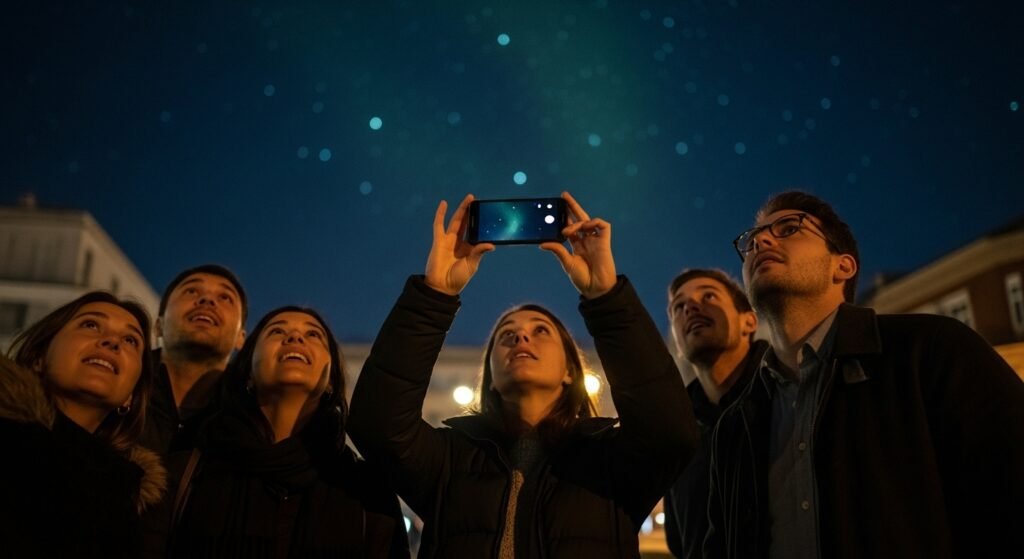
Within minutes of the first sightings, social media platforms were flooded with content. Hashtags related to the glowing sky began trending. Amateur photographers shared long-exposure shots that revealed intricate details invisible to the naked eye. Videographers posted clips showing the slow, majestic evolution of the cloud. Comment sections filled with a mixture of awe, confusion, and humor, as people tried to make sense of what they had witnessed.
This rapid, crowdsourced documentation is one of the remarkable features of modern skywatching. In the past, a strange phenomenon in the sky might have been seen by a few people and dismissed or forgotten. Today, thousands of cameras capture it from different angles, and experts can analyze the footage almost in real time. Within an hour of the space jellyfish appearing, astronomers and spaceflight trackers had pieced together a likely explanation, cross-referencing the time and location of the sightings with known rocket launch schedules.
The Possible Connection to a SpaceX Launch
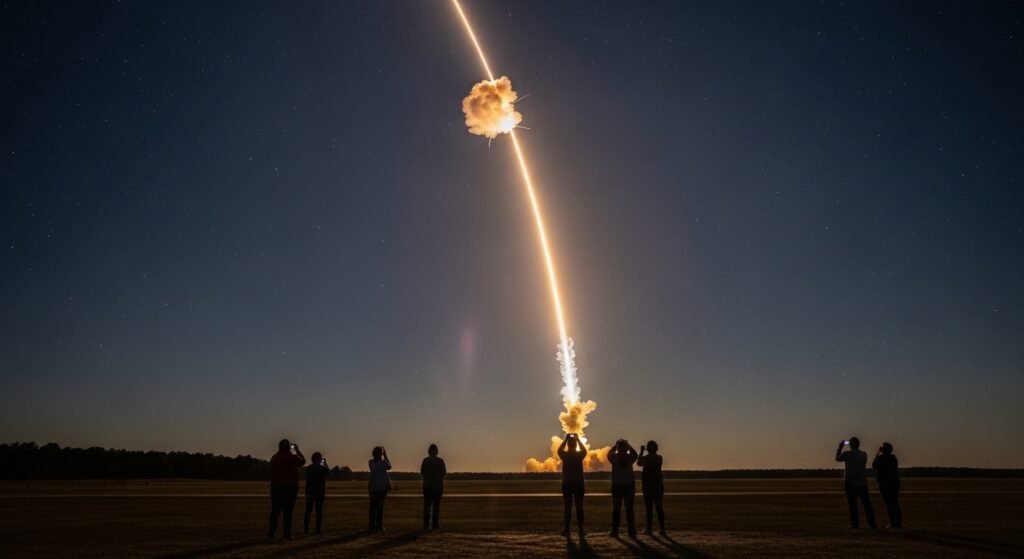
The timing was the biggest clue. SpaceX had launched a Falcon 9 rocket earlier that evening, carrying a payload of Starlink internet satellites into low Earth orbit. The launch trajectory, the timing of the upper-stage engine burns, and the geographic distribution of the sightings all lined up. When a Falcon 9’s second stage fires its engine at high altitude, it releases a plume of exhaust gases, primarily water vapor and carbon dioxide, into the thin upper atmosphere. Around twilight, when the ground is dark but the upper atmosphere is still sunlit, this exhaust can glow brilliantly.
SpaceX launches have become so frequent that these twilight phenomena are now a semi-regular occurrence, delighting skywatchers along the flight path. The company launches dozens of times per year, and each twilight launch has the potential to create a visible display. What made this particular event so widely seen was a combination of favorable weather, with clear skies over much of the eastern United States, and a launch time that placed the rocket in sunlight while observers on the ground were in darkness. It was, in essence, a perfect alignment of orbital mechanics, atmospheric optics, and clear weather.
Why It Looked Like a Jellyfish
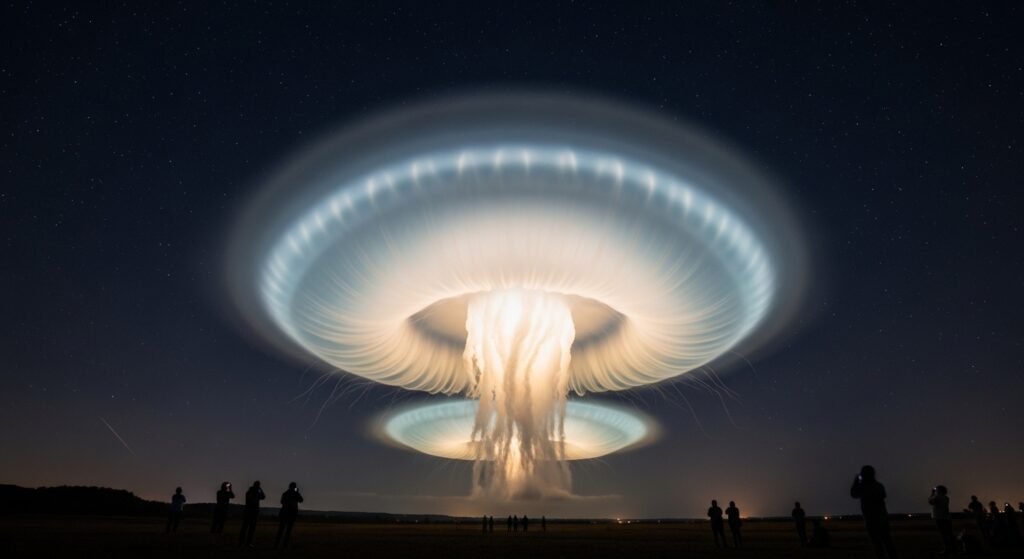
The jellyfish appearance is a product of fluid dynamics and lighting geometry. When the rocket engine fires in the near-vacuum of the upper atmosphere, the exhaust does not behave the way it does at sea level. With almost no air pressure to contain it, the plume expands rapidly in all directions, forming a vast, tenuous cloud. The brightest region, near the engine nozzle, forms the bell of the jellyfish. The expanding gases, spreading outward and illuminated from below by the sun, form the wispy tentacles.
The colors add to the ethereal effect. The exhaust is primarily lit by scattered sunlight, which can give it a blue-white or pearly glow. As the cloud expands and thins, different regions catch the light differently, creating gradients and subtle color variations. Long-exposure photographs often reveal even more detail, showing spiral structures and filamentary textures caused by the interaction of the exhaust with the rarefied upper atmosphere. It is a genuinely beautiful example of physics creating art.
Not the First Time People Have Seen This

While this particular space jellyfish generated enormous attention, it was far from the first. Similar displays have been observed and photographed for decades, dating back to the early days of spaceflight. In 2017, a Russian rocket launch created a spectacular glowing spiral over Siberia that was widely photographed. In 2022, a SpaceX launch produced a stunning twilight display over the southeastern United States. Each event generates a fresh wave of wonder, in part because each one is slightly different, shaped by the specific trajectory, timing, and atmospheric conditions of that launch.
These recurring events have created a community of dedicated twilight-launch watchers who track launch schedules and weather forecasts, hoping to catch the next display. Photography forums and astronomy groups share tips on the best viewing locations and camera settings. For many, witnessing a space jellyfish has become a bucket-list experience, a reminder that the space age is not some distant abstraction but something that can paint the sky above your own backyard.
Curiosity Naturally Follows

One of the most heartening aspects of the space jellyfish event was the curiosity it inspired. Children asked their parents what it was. Teachers used it as a jumping-off point for lessons about rockets, atmospheres, and optics. Amateur astronomers found themselves fielding questions from neighbors who had never shown an interest in the night sky before. In a world where it can feel like wonder is in short supply, a glowing jellyfish in the heavens reminded millions of people to look up.
This curiosity is valuable. Public interest in spaceflight helps sustain support for scientific exploration and technological innovation. When people see a rocket launch with their own eyes, even indirectly through its exhaust plume, space becomes tangible and real. It is no longer just something that happens on television. It is something that can light up your evening sky. That sense of connection matters, and it is one of the unintended but welcome consequences of the increasing cadence of commercial spaceflight.
The Role of Light and Atmosphere
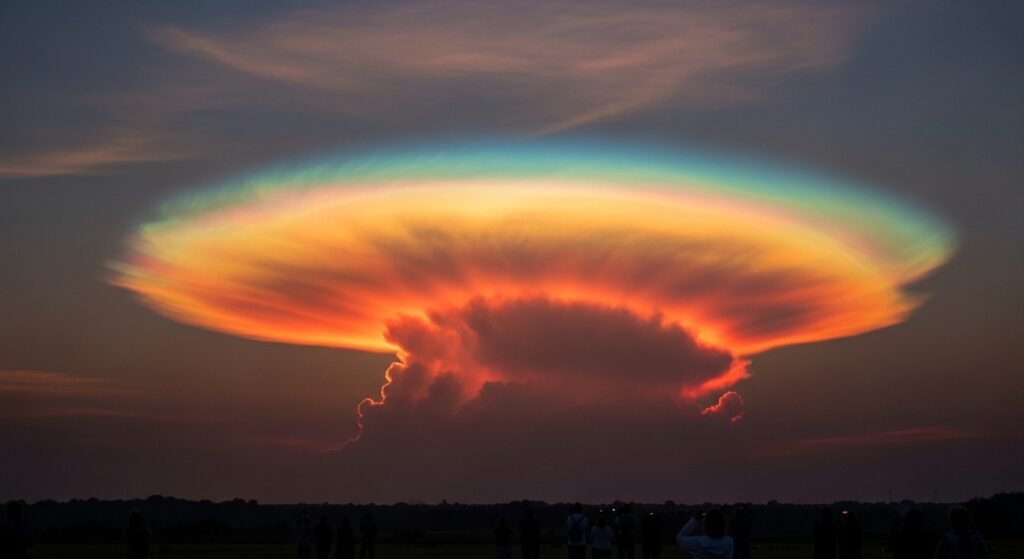
The physics behind the space jellyfish is a beautiful illustration of how light and atmosphere interact. The key factor is the twilight geometry. After the sun has set at ground level, it can still be shining on objects at high altitude. This is the same principle that makes high clouds glow pink and orange after sunset. A rocket at 100 kilometers altitude can be in full sunlight while observers on the ground are in twilight darkness, creating maximum contrast and making the exhaust plume appear to glow against a dark sky.
The upper atmosphere itself plays a crucial role. At the altitudes where these displays occur, the air is incredibly thin, less than a millionth of the density at sea level. Exhaust gases expand freely and can persist for a long time before dissipating. Ice crystals can form in the plume, creating additional optical effects. The result is a display that can last for many minutes and evolve continuously, unlike lower-altitude phenomena that fade quickly. Understanding these mechanics does not diminish the beauty of the sight. If anything, it deepens our appreciation, revealing the elegant physics behind the spectacle.
Families and Friends Shared the Moment

Perhaps the most enduring legacy of the space jellyfish event is not scientific but human. Across the country, people experienced it together. Neighbors called to each other from porches. Families piled into cars and drove to open fields for a better view. Friends texted photos back and forth, comparing what they saw from different locations. In an era when shared experiences can feel increasingly rare, the glowing jellyfish gave millions of strangers a common moment of wonder.
These are the moments that become family stories, retold for years. Do you remember the night the sky turned into a jellyfish? As the cadence of spaceflight continues to increase, with more launches and more satellites, these twilight displays are likely to become more common. Each one is a reminder that we live in an extraordinary time, when human engineering can paint the heavens. The next time a rocket launches at twilight, step outside and look up. You might just catch the next space jellyfish, and you will have a story to tell.